
Latest News & Updates
Follow all activities, events, official statements, and workshops of the Palestinian Smart Youth Parliament.
News Summary
📰 News Summary 🎙️ Presented by: Ghada Tabash ✍🏻 Edited by: Taysir Qadi'h 📌 General Supervision: Ghada Tabash ــــــــــــــــــــــــــــــ 📡 Media and Digital Communication Unit We are with you continuously, 24 hours a day. 🕒 #News_Summary #Media_and_Digital_Communication_Unit

Israel on the Brink of a War Decision: Netanyahu and Eizenkot in a Power Struggle... and Iran at the Heart of Regional Calculations
Israel on the Brink of a War Decision: Netanyahu and Eizenkot in a Power Struggle... and Iran at the Heart of Regional Calculations A Reading in Political Psychology and the Interplay of National Security with the Battle of Forming the Israeli Government By: Dr. Abdul Karim Abu Mustafa The issue in Israel is no longer merely a disagreement over the timing of a military strike against Iran, nor just a divergence in the military establishment's assessments regarding the level of the Iranian threat. We are faced with a more complex scene where war calculations intertwine with power struggles, and security considerations are entangled with constitutional obligations, while Washington turns into a decisive factor in determining the direction of the upcoming confrontation. On November 12, 2026, political and security developments revealed a striking paradox: Israel is raising its readiness level for the possibility of renewed war with Iran, while the military establishment, according to Channel 13, sees no urgent necessity for an immediate Israeli attack, preferring to join any American military operation if President Donald Trump decides to carry it out. At the same time, the crisis of forming the government continues, after Gadi Eizenkot was tasked with forming the new Israeli government, while Benjamin Netanyahu continues to head the caretaker government and retains the powers to manage the security and military establishment. This is not just a temporal coincidence; it is a moment where three existential questions intersect: Who rules Israel? Who has the decision for war? And can regional escalation be utilized to rearrange the internal political power balances? First: Netanyahu... Between Decision Authority and Pressures of Political Transition Benjamin Netanyahu faces an exceptional political situation. He is still the head of the government, but he no longer holds the parliamentary majority that allows him to continue ruling according to the new Knesset balances. In contrast, Gadi Eizenkot has been tasked with forming the government after his supporting camp received recommendations from 67 members, compared to 46 for Netanyahu, according to the data that followed the Israeli elections on October 27. Eizenkot has an initial constitutional deadline of 28 days, with the possibility of extending it for an additional 14 days, to form a coalition that enjoys the confidence of the Knesset. Here the dilemma appears: Netanyahu possesses the powers of the existing government, while Eizenkot is working to build the next government. This overlap between the existing authority and the authority seeking to arrive creates an extremely sensitive space, especially when it comes to military decisions that could lead to regional war. From the perspective of political psychology, this situation can be read through the concept of power struggle in the transitional phase; the ability of political leadership to maneuver in the Knesset diminishes, while it still retains the tools of executive and security authority. Here the question becomes related to the limits of using powers during the transitional phase, not just who legally possesses them. Second: Eizenkot... The Battle for Oversight on the War Decision Gadi Eizenkot's move was not merely a political objection to Netanyahu, but was linked to the demand for regular security briefings and ensuring institutional oversight on military decisions during the government formation phase. Eizenkot demanded the legal advisor's intervention to ensure he receives security briefings and warned against executing military operations that are not imposed by an immediate and urgent security necessity, due to the potential repercussions on Israeli democracy and public trust in state institutions. Netanyahu responded by accusing him of politicizing security issues, asserting that his government's decisions are based on security considerations and coordination with the military establishment. On November 12, the two parties held a security and political meeting that lasted more than two hours, attended by the military secretary to the Prime Minister, and they agreed to continue exchanging security briefings and updates. However, the significance of the meeting goes beyond its protocol image; the presence of a transitional Prime Minister and a party leader tasked with forming the next government in a security briefing session reflects the sensitivity of the phase and the limits of trust between the two sides of the political equation. Moreover, Avigdor Lieberman's warnings against making decisions that could lead to war without parliamentary oversight and broad security consensus indicate that the issue is no longer a bilateral disagreement between Netanyahu and Eizenkot, but has become a broader discussion about the legitimacy of the security decision during the transitional phase. Third: Iran... Military Preparedness Without an Announced Necessity for Immediate Attack Iran seems to be at the heart of this equation. According to what was reported by the Israeli Broadcasting Authority "Kan", directives were issued to the military establishment to raise the level of readiness for scenarios related to a potential confrontation with Iran. In contrast, Channel 12 reported that the security establishment does not see in the current Iranian movements any justification for launching an immediate attack at the current political timing. Channel 13 reported that the army's position presented to Netanyahu and Eizenkot is that there is no urgent necessity for a unilateral Israeli attack, preferring Israel's participation if the United States decides to carry out a military operation against Tehran. These data reveal the necessity to distinguish between three levels: 1. Military readiness: raising readiness and preparedness for confrontation possibilities. 2. Operational assessment: determining whether there is a threat that necessitates an immediate military strike. 3. Political decision: determining the timing of war, its scope, and the parties involved. The three levels may coincide without necessarily meaning that a decision for war has been made. From here, the importance of the American position emerges. The Israeli military establishment, according to the narrative conveyed by Channel 13, does not treat any new confrontation as necessarily an Israeli operation alone, but places American participation at the core of its calculations. This reflects the extent of Israeli reliance on the American umbrella in managing major strategic confrontations, especially when the possibilities of Iranian retaliation and the widening scope of war are present in military assessments. Fourth: Trump... The Party That May Determine the Ceiling of Confrontation The Israeli calculations cannot be understood in isolation from Washington. The American position is not limited to providing military and political support to Israel, but extends to influencing the timing of operations, their limits, and their regional costs. International reports circulate American messages urging Israel and Gulf states to prepare for the possibility of renewed war with Iran. However, readiness does not mean that a final American decision for confrontation has been issued. Here lies the paradox: Israel may wish to retain the military option, but it cannot ignore the cost of confrontation if it does not have American participation or a clear strategic umbrella. As for Trump, he finds himself facing intertwined options between political pressure, sanctions, negotiations, and military threats. Thus, the question is not only whether Washington will participate in the war, but to what extent it is prepared to bear its regional consequences, and whether it sees that military confrontation achieves objectives that other pressure tools cannot. Fifth: Turkey and Greece... The Eastern Mediterranean Enters the Calculations Alongside the tension with Iran, developments in the Eastern Mediterranean emerge as an additional pathway in Israeli security calculations. Military cooperation between Israel and Greece, and their joint naval exercises, reflect the continued building of security partnerships in a region witnessing escalating competition for influence, maritime passages, and energy resources. Moreover, the tension related to the Turkish-Libyan maritime agreement adds another dimension to regional competition. Here, these developments should be viewed within a broader context: Israel does not deal with its security solely through the Iranian front, but within a network of balances that includes Turkey, the Eastern Mediterranean, Greece, and the United States. However, these pathways should not be conflated; Israeli-Greek cooperation does not necessarily imply a decision to open a military confrontation with Turkey, nor do military exercises alone represent evidence of an intention for war. They are indicators of rearranging partnerships and deterrence balances in a region where strategic competition is increasing. Sixth: Could Iran Be a Gateway to Change the Israeli Political Equation? This is the most sensitive point in the scene. From the perspective of political psychology, the behavior of the parties can be explained through three concepts: 1. Aversion to Political Loss: When a politician feels that their position is threatened, the potential loss becomes more present in their calculations than future gains. This may affect how they deal with crises and external threats. 2. Uniting the Group Against External Threat: Historically, external threats may lead to strengthening the rally around leadership, temporarily diminishing internal disagreements. However, this effect is not guaranteed, especially when trust in institutions and leadership is in dispute. 3. Crisis of Legitimacy and Institutional Trust: When the military establishment and political leadership disagree on the timing of using force, the military decision becomes a test of the relationship between authority, oversight, and national responsibility. From this standpoint, it cannot be asserted that Netanyahu seeks war for electoral or personal reasons, but it is legitimate to analyze the potential impact of escalation on his political position, on the negotiations for forming the government, and on Eizenkot's ability to complete his mission. War may postpone political disagreements, accelerate consensus on an emergency government, and conversely deepen internal division if its costs become a political burden on the existing leadership. Seventh: Three Scenarios for the Future of Government Formation In light of these data, three political pathways can be envisioned: Scenario One: Forming an Expanded Government or Emergency Government. Fears of renewed war with Iran may push political forces to transcend their disagreements and form a government that grants security decisions broader political cover and distributes responsibility for the upcoming phase. Scenario Two: Freezing Government Negotiations. The escalation of military risks may slow negotiations, lead to a reevaluation of alliances, and await clarification of the American and Iranian positions before entering into long-term governmental understandings. Scenario Three: Continuing the Power Struggle in Parallel with Negotiations. This means Netanyahu continues to manage the government and security agencies, alongside Eizenkot's attempts to form the new coalition, with escalating debate over the limits of the transitional government's powers and parliamentary oversight on war decisions. This scenario places Israeli institutions before a constitutional and political test, especially since forming the government does not necessarily stop with the end of regional tensions. Eighth: What Do These Developments Mean for Gaza? Gaza cannot be outside these calculations. Any new Israeli escalation towards Iran may rearrange Israeli military and security priorities and affect the nature of managing other fronts, including Gaza, Lebanon, and Syria. However, this does not necessarily mean that escalation with Iran will lead to a reduction of operations in Gaza; Israel may seek to distribute its military efforts, or attempt to manage multiple fronts in parallel, or use regional escalation to change negotiation and pressure priorities. For the Gaza Strip, the continued state of Israeli political and security uncertainty places the future of administrative, humanitarian arrangements, and reconstruction before additional challenges. The decisions made by the Israeli leadership regarding Iran are not confined to the limits of the Iranian-Israeli confrontation, but their effects can extend to the entire region, including the lives of Palestinians and the future of the Gaza Strip. Conclusion: The Struggle is Not Only for War... But for Who Holds Its Decision What is happening in Israel today reveals an unusual intertwining between the crisis of forming the government and the decision for war, and between national security calculations and competition for power. Netanyahu still possesses the tools of governance, Eizenkot has the mandate to form the government, and the military establishment is raising its level of readiness, but it does not announce, according to the conveyed reports, the necessity for an immediate Israeli attack on Iran, while Washington remains an influential factor in determining the direction of the confrontation. In contrast, Israel operates within a more complex regional environment, where Iran, Gaza, Turkey, and the Eastern Mediterranean intertwine, and the difficulty of separating military deterrence from political bargaining increases. In my opinion, the essence of the current Israeli moment lies not only in the possibility of a new war with Iran but in the crisis of decision-making within Israel: Can security and political institutions separate the strategic interest of the state from the calculations of the power struggle? War may be a military decision at a certain moment, but in this case, it also carries constitutional, political, and regional dimensions. The question that will determine the direction of the next phase is not only: Will Israel strike Iran? But: Will the decision for war remain a security decision governed by threat assessments and strategic interest, or will it turn into a card in the battle for reshaping power within Israel? That is the question we should monitor, as it may reveal much about the future of confrontation in the region, and about the pathways awaiting Gaza, Iran, and the Eastern Mediterranean in the next phase.
Israel on the Brink of a War Decision: Netanyahu and Eizenkot in a Power Struggle.. and Iran at the Heart of Regional Calculations
Israel is on the brink of a war decision: Netanyahu and Eizenkot are in a power struggle, while Iran is at the heart of regional calculations. A reading in political psychology and the intertwining of national security with the battle for forming the Israeli government. By: Dr. Abdulkarim Abu Mustafa The issue in Israel is no longer merely a disagreement over the timing of a military strike against Iran, nor just a divergence in the military establishment's assessments regarding the level of the Iranian threat. We are facing a more complex scene where war calculations intertwine with power struggles, and security considerations overlap with constitutional obligations, while Washington turns into a decisive factor in determining the direction of the upcoming confrontation. On November 12, 2026, political and security developments revealed a striking paradox: Israel is raising its level of preparedness for the possibility of renewed war with Iran, while the military establishment, according to Channel 13, does not see an urgent necessity for an immediate Israeli attack, preferring to join any American military operation if President Donald Trump decides to carry it out. At the same time, the crisis of forming a government continues, after Gadi Eizenkot was tasked with forming the new Israeli government, while Benjamin Netanyahu continues to head the caretaker government and retains powers to manage the security and military establishment. This is not just a temporal coincidence; it is a moment where three existential questions intersect: Who governs Israel? Who has the power to decide on war? And can regional escalation be utilized to rearrange the internal political power balances? First: Netanyahu.. Between Decision-Making Authority and Pressures of Political Transition Benjamin Netanyahu faces an exceptional political situation. He is still the Prime Minister, but he no longer has the parliamentary majority that allows him to continue ruling according to the new Knesset balances. In contrast, Gadi Eizenkot has been tasked with forming the government after his supporting camp received recommendations from 67 deputies, compared to 46 for Netanyahu, according to the data that followed the Israeli elections on October 27. Eizenkot has an initial constitutional deadline of 28 days, with the possibility of extending it for an additional 14 days, to form a coalition that enjoys the confidence of the Knesset. Here the dilemma arises: Netanyahu possesses the powers of the existing government, while Eizenkot is working to build the next government. This overlap between the existing authority and the authority seeking to arrive creates an extremely sensitive space, especially when it comes to military decisions that could lead to regional war. From the perspective of political psychology, this situation can be read through the concept of influence struggle during the transitional phase; the ability of political leadership to maneuver in the Knesset diminishes, while it still retains the tools of executive and security authority. Here the question becomes related to the limits of using powers during the transitional phase, not just about who legally possesses them. Second: Eizenkot.. The Battle for Oversight on the War Decision Gadi Eizenkot's move was not merely a political objection to Netanyahu, but was linked to the demand for regular security briefings and ensuring institutional oversight on military decisions during the government formation phase. Eizenkot requested the legal advisor's intervention to ensure he receives security briefings and warned against executing military operations that are not imposed by an immediate and urgent security necessity, due to the potential repercussions on Israeli democracy and public trust in state institutions. Netanyahu responded by accusing him of politicizing security issues, asserting that his government's decisions are based on security considerations and coordination with the military establishment. On November 12, the two parties held a security and political meeting that lasted more than two hours, attended by the military secretary to the Prime Minister, and they agreed to continue exchanging security briefings and updates. However, the significance of the meeting goes beyond its protocol image; the presence of a transitional Prime Minister and a party leader tasked with forming the next government in a security briefing session reflects the sensitivity of the phase and the limits of trust between the two sides of the political equation. Moreover, Avigdor Lieberman's warnings against making decisions that could lead to war without parliamentary oversight and broad security consensus indicate that the issue is no longer a bilateral dispute between Netanyahu and Eizenkot, but has become a broader discussion about the legitimacy of security decisions during the transitional phase. Third: Iran.. Military Preparedness Without an Announced Necessity for Immediate Attack Iran seems to be at the heart of this equation. According to what was reported by the Israeli Broadcasting Authority "Kan", directives were issued to the military establishment to raise the level of preparedness for scenarios related to a potential confrontation with Iran. In contrast, Channel 12 reported that the security establishment does not see in the current Iranian movements any justification for launching an immediate attack in the current political timing. As for Channel 13, it reported that the army's position presented to Netanyahu and Eizenkot is that there is no urgent necessity for a unilateral Israeli attack, preferring Israel's participation if the United States decides to carry out a military operation against Tehran. These data reveal the necessity to distinguish between three levels: 1. Military preparedness: Raising readiness and preparedness for confrontation possibilities. 2. Operational assessment: Determining whether there is a threat that warrants an immediate military strike. 3. Political decision: Determining the timing of war, its scope, and the parties involved. The three levels may coincide without necessarily meaning that a war decision has been made. From here, the importance of the American position emerges. The Israeli military establishment, according to the narrative conveyed by Channel 13, does not treat any new confrontation as necessarily an Israeli operation alone, but places American participation at the core of its calculations. This reflects the extent of Israeli reliance on the American umbrella in managing major strategic confrontations, especially when the possibilities of Iranian retaliation and the escalation of war are present in military assessments. Fourth: Trump.. The Party That May Determine the Ceiling of Confrontation Israeli calculations cannot be understood in isolation from Washington. The American position is not limited to providing military and political support to Israel, but extends to influencing the timing of operations, their limits, and their regional costs. International reports circulate American messages calling on Israel and Gulf states to prepare for the possibility of renewed war with Iran. However, preparedness does not mean that a final American decision for confrontation has been issued. Here lies the paradox: Israel may wish to retain the military option, but it cannot ignore the cost of confrontation if it does not have American participation or a clear strategic umbrella. As for Trump, he finds himself facing intertwined options between political pressure, sanctions, negotiation, and military threat. Thus, the question is not only whether Washington will participate in the war, but to what extent it is prepared to bear its regional consequences, and whether it sees that military confrontation achieves goals that other pressure tools cannot achieve. Fifth: Turkey and Greece.. The Eastern Mediterranean Enters the Calculations Alongside the tension with Iran, developments in the Eastern Mediterranean emerge as an additional pathway in Israeli security calculations. Military cooperation between Israel and Greece, and their joint naval exercises, reflect the continued building of security partnerships in a region witnessing escalating competition for influence, maritime routes, and energy resources. Moreover, the tension related to the Turkish-Libyan maritime agreement adds another dimension to regional competition. Here, these developments should be viewed within a broader context: Israel does not deal with its security solely through the Iranian front, but within a network of balances that includes Turkey, the Eastern Mediterranean, Greece, and the United States. However, these pathways should not be confused; Israeli-Greek cooperation does not necessarily mean a decision to open a military confrontation with Turkey, nor do military exercises alone represent evidence of a war intention. They are indicators of rearranging partnerships and deterrence balances in a region where strategic competition is increasing. Sixth: Could Iran Be an Entry Point for Changing the Israeli Political Equation? This is the most sensitive point in the scene. From the perspective of political psychology, the behavior of the parties can be explained through three concepts: 1. Aversion to political loss: When a politician feels that their position is threatened, the potential loss becomes more present in their calculations than future gains. This may affect how they deal with crises and external threats. 2. Unifying the group in the face of external threat: Historically, external threats may lead to strengthening the rally around leadership, temporarily reducing internal disagreements. However, this effect is not guaranteed, especially when trust in institutions and leadership is disputed. 3. Crisis of legitimacy and institutional trust: When the military establishment and political leadership disagree on the timing of using force, the military decision becomes a test of the relationship between authority, oversight, and national responsibility. From this standpoint, it cannot be asserted that Netanyahu seeks war for electoral or personal reasons, but it is legitimate to analyze the impact of potential escalation on his political position, on the negotiations for forming the government, and on Eizenkot's ability to complete his mission. War may postpone political disagreements, it may accelerate consensus on an emergency government, and conversely, it may deepen internal division if its costs become a political burden on the existing leadership. Seventh: Three Scenarios for the Future of Government Formation In light of these data, three political pathways can be envisioned: Scenario One: Forming an Expanded Government or an Emergency Government. Fears of renewed war with Iran may push political forces to overcome their disagreements and form a government that grants security decisions broader political cover and distributes responsibility for the upcoming phase. Scenario Two: Freezing Government Negotiations. The escalation of military risks may slow down negotiations, lead to a reevaluation of alliances, and await the clarification of the American and Iranian positions before entering into long-term governmental understandings. Scenario Three: Continuing the Struggle for Powers in Parallel with Negotiations. This means that Netanyahu continues to manage the government and security agencies, alongside Eizenkot's attempts to form the new coalition, with rising debate over the limits of the transitional government's powers and parliamentary oversight on war decisions. This scenario places Israeli institutions before a constitutional and political test, especially since forming the government does not necessarily stop with the end of regional tensions. Eighth: What Do These Developments Mean for Gaza? Gaza cannot be outside these calculations. Any new Israeli escalation towards Iran may rearrange Israeli military and security priorities and affect the nature of managing other fronts, including Gaza, Lebanon, and Syria. However, this does not necessarily mean that escalation with Iran will lead to a reduction of operations in Gaza; Israel may seek to distribute its military efforts, or attempt to manage several fronts in parallel, or use regional escalation to change negotiation and pressure priorities. For the Gaza Strip, the continuation of Israeli political and security uncertainty places the future of administrative, humanitarian arrangements, and reconstruction before additional challenges. The decisions made by the Israeli leadership regarding Iran are not confined to the limits of the Iranian-Israeli confrontation, but their effects can extend to the entire region, including the lives of Palestinians and the future of the Gaza Strip. Conclusion: The Struggle is Not Only for War.. But for Who Holds Its Decision What is happening in Israel today reveals an unusual intertwining between the government formation crisis and the war decision, and between national security calculations and the struggle for power. Netanyahu still possesses the tools of governance, Eizenkot has the mandate to form the government, and the military establishment raises its level of preparedness, but it does not declare, according to the conveyed reports, the necessity of executing an immediate Israeli attack on Iran, while Washington remains an influential factor in determining the direction of confrontation. In contrast, Israel operates within a more complex regional environment, where Iran, Gaza, Turkey, and the Eastern Mediterranean intertwine, and it becomes increasingly difficult to separate military deterrence from political bargaining. In my estimation, the essence of the current Israeli moment lies not only in the possibility of a new war with Iran but in the crisis of decision-making within Israel: Can the security and political institutions separate the strategic interest of the state from the calculations of the power struggle? War may be a military decision at a certain moment, but in this case, it also carries constitutional, political, and regional dimensions. The question that will determine the direction of the next phase is not only: Will Israel strike Iran? But: Will the decision of war remain a security decision governed by threat assessments and strategic interest, or will it turn into a card in the battle for reshaping power within Israel? That is the question we should monitor, as it may reveal much about the future of confrontation in the region, and about the pathways awaiting Gaza, Iran, and the Eastern Mediterranean in the next phase.

Regional Escalation and the Interim Government: Towards Forced Consensus or Political Stagnation by Salam Hamamda
Regional Escalation and the Interim Government: Towards Forced Consensus or Political Stagnation Between the hammer of threats and the anvil of internal arrangements: Will security developments accelerate or freeze the path of the interim government? In the midst of rapid regional developments and sensitive security briefings, alongside noticeable shifts in the tone of threats directed at Iran, the political scene finds itself at a critical crossroads. These factors do not only have military strategic implications but also cast heavy and direct shadows on the structure of internal political work, particularly regarding the formation of an interim government to manage affairs during this critical phase. A careful reading of the nature of these developments presents observers with two parallel scenarios, each revealing a different approach by political forces in dealing with crises: Scenario One: Urgency and Favoring Partnership Proponents of this view believe that the escalation of security threats and the rising level of regional tension should serve as a real wake-up call for political forces, pushing them to transcend narrow partisan disagreements. The exceptional phase inherently requires a broad national umbrella and an interim government capable of making fateful decisions and bearing the burden of facing challenges with unified effort and a solid political cover. Scenario Two: The Hypothesis of Stagnation and Reevaluation Conversely, another direction suggests that critical security briefings and the ambiguity associated with escalation possibilities may inevitably lead to a temporary freeze of governmental movement. Under such circumstances, leaderships and concerned parties often become preoccupied with managing the field and military crisis, causing parties to hesitate in entering fragile governmental understandings while waiting for the major outlines of the upcoming phase to become clear. Summary of the Scene: The intense overlap between the security file and the political entitlement makes it difficult to definitively favor one of the two paths. The compass of decision today is determined by the extent to which the parties can leverage threats as a catalyst for national consensus or retreat recently towards cautious crisis management. Between this and that, the coming days remain capable of revealing the true direction of events.
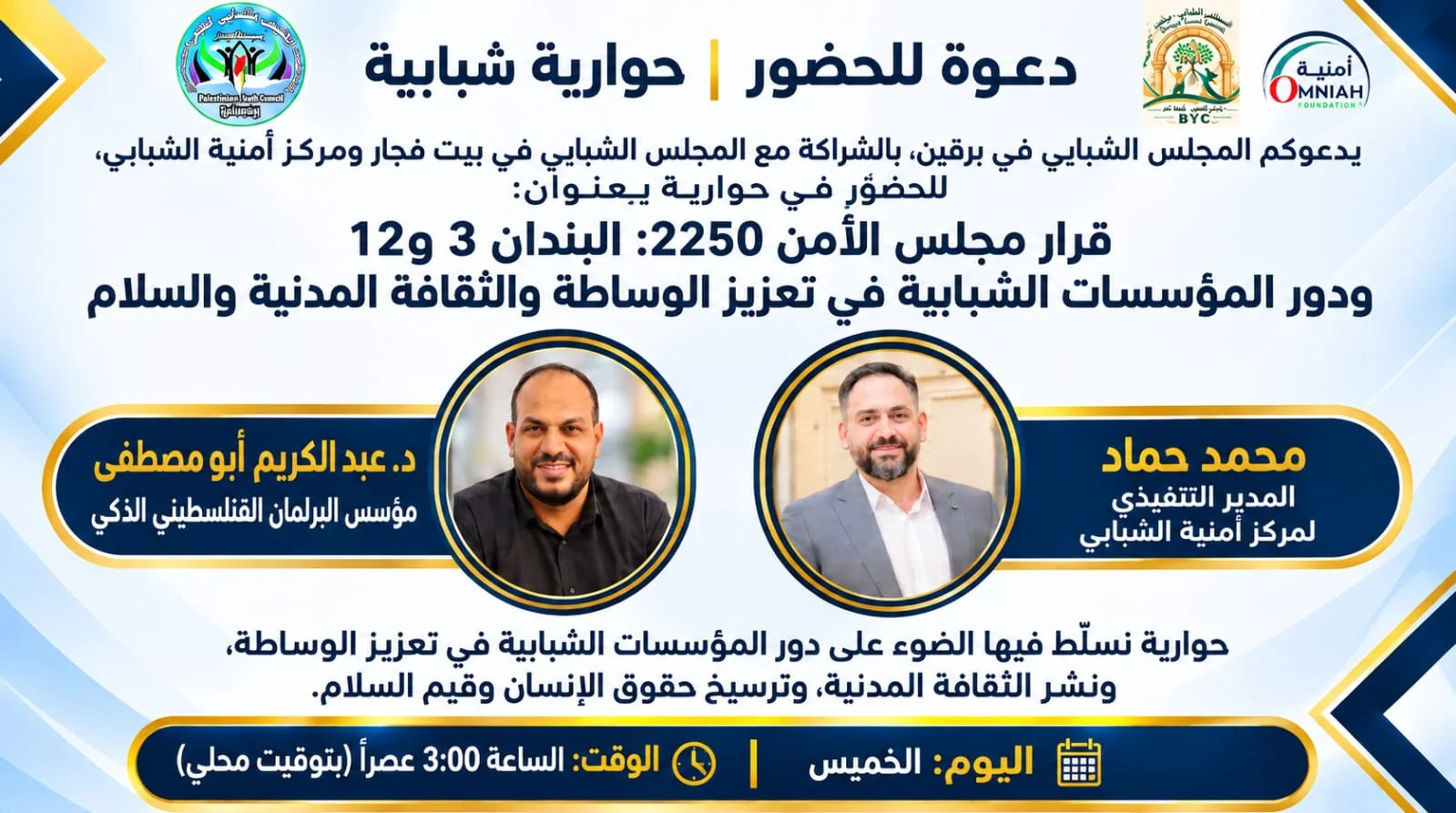
Invitation to a Youth Dialogue
The Youth Council in Burqin, in partnership with the Youth Council in Beit Fajjar and the Amani Youth Center, invites you to attend and participate in a youth dialogue titled: "UN Security Council Resolution 2250: Articles 3 and 12, and the Role of Youth Institutions in Promoting Mediation, Civil Culture, and Peace" With participation from: - Dr. Abdul Karim Abu Mustafa – Founder of the Palestinian Smart Youth Parliament. - Mohammad Hamad – Executive Director of the Amani Youth Center. The dialogue will highlight the role of youth institutions in promoting mediation, spreading civil culture, and establishing human rights and values of peace. Date: Today, Thursday. Time: 3:00 PM (local time). Participation link via Google Meet: https://meet.google.com/eip-zjgq-wpg Welcome!
Are These the Achievements of October 7, Dr. Hamami? By: Alaa Abdel Fattah Hamid
Are These the Achievements of October 7, Dr. Hamami? By: Alaa Abdel Fattah Hamid Member of the General Union of Palestinian Historians Today, I followed the episode of 'Opposite Direction' featuring the wonderful professor Nidal Said Al-Sab' who, as usual, was brilliant and logical, presenting numbers and facts, alongside Ibrahim Hamami who, as usual, brought slogans. The most amusing moment in the entire episode was when Faisal Qassem asked the guest about the achievements of October 7, and Dr. Hamami sat counting as if he were tallying great spoils and achievements, which were: 1. The resignation of 15 Israeli political figures!!! 2. The withdrawal of some countries from the Eurovision Song Contest!!! 3. An Israeli being expelled from a restaurant in Thailand!!! No, man? Are these achievements? Dr. Hamami, with all due respect to your qualifications, we are talking about Gaza, which has been leveled to the ground, with nearly 80,000 martyrs, about two million displaced people living in nylon tents, about a whole generation that has lost its limbs, about a famine unseen in history, and you come to tell me our achievement is that 15 Israeli officials resigned? And do you know that those who resigned are among the most extreme criminals and have been replaced by even more criminal ones? And does the resignation of an official in Netanyahu's government restore even one home in Jabalia or Rafah?! The second achievement is the great withdrawal of countries from Eurovision!!! God is Great, Palestine is liberated!!! The Zionist project has fallen because a singer from Ireland said she wouldn't sing with an Israeli. Is this the clear victory you promised us? Do the blood of our children equal a boycott of a lowly singing contest that no one in Gaza watches because there is no electricity at all!!! As for the third achievement that generals wouldn't even think of, an Israeli being expelled from a restaurant in Thailand!!! Wow, the Israeli economy has collapsed; the Israeli army that bombs us with F-35s will collapse because it didn't eat Pad Thai in Bangkok. This is the logic of amateurs that Professor Nidal Al-Sab' brilliantly exposed. Nidal stated the bitter truth that you do not want to hear: resistance is a noble and sacred act when it has a political horizon and considers its people. However, throwing your entire people into the furnace and then coming out to say we have won because the world expels an Israeli from a restaurant is not resistance; this is gambling with our blood. Nidal Al-Sab' asked a simple question that Hamami could not answer: What next? What is the plan for the next day? Where is the political project? The answer was Eurovision!!! Dr. Hamami, we do not want to expel Israelis from restaurants in Thailand; we want to return to our restaurants and homes. We do not want the resignation of 15 Israeli officials; we want the survival of 15,000 children—our children—alive. Enough with the trading of empty slogans; what Nidal Al-Sab' said is pure reason and represents us in Gaza.
News Summary
📰 News Summary 🎙️ Presented by: Ahmad Al-Halaika ✍🏻 Edited by: Taysir Qadi'h 📌 General Supervision: Ghada Tabash ــــــــــــــــــــــــــــــ 📡 Media and Digital Communication Unit With you first-hand, 24 hours a day. 🕒 #News_Summary #Media_and_Digital_Communication_Unit

Hussein Al-Sheikh in an Interview with Al-Arabiya: A Reading of the Political Psychology of the Discourse and Messages of the Next Phase by Dr. Abdul Karim Abu Mustafa
Hussein Al-Sheikh in an Interview with Al-Arabiya: A Reading of the Political Psychology of the Discourse and Messages of the Next Phase By: Dr. Abdul Karim Abu Mustafa The interview of Palestinian Vice President Hussein Al-Sheikh on Al-Arabiya was not merely a media appearance addressing a range of current political files, but can be read as a space to reveal the nature of the discourse that the Palestinian leadership is trying to present in a highly sensitive phase, intersecting with the challenges of the war on Gaza, the future of the Palestinian political system, the relationship with Hamas, transformations within Israel, and the future of Palestinian leadership in the post-Mahmoud Abbas era. The importance of the interview lies not only in the content of the answers but also in the language used, the nature of the files that were focused on, and the messages that can be drawn from the arrangement of political priorities and the way contentious issues were addressed. From the perspective of political psychology, political discourse is not read as a collection of separate statements, but rather as an expression of the leadership's perceptions of power balances, sources of threat, fears of losing control, and attempts to maintain legitimacy and reproduce trust. First: From the Discourse of a Responsible Official to the Discourse of a Statesman One of the most prominent features that can be observed in Hussein Al-Sheikh's language is the broadening scope of the discourse, as it did not limit itself to issues related to his executive position but extended to matters concerning the future of the Palestinian political system, national decision unity, regional and international relations, negotiations, reforms, and elections. This breadth gives the discourse a character that transcends presenting immediate positions to attempting to offer a comprehensive vision for managing the upcoming phase. In political psychology, this type of discourse is associated with an attempt to build a leadership image capable of handling multiple files and presenting itself as a party with a vision that transcends administrative jurisdiction to the level of comprehensive national responsibility. However, possessing the language of a statesman does not necessarily mean possessing a state project; the true criterion lies in the ability to translate political perceptions into programs, institutions, and tangible results. Second: Hamas and the Unity of Arms... A Struggle for Decision-Making Authority The file of the relationship with Hamas was one of the most prominent axes of the interview, especially regarding the equation of one authority, one law, and one weapon. This phrase carries a meaning that transcends the security aspect; it reflects a perception of the nature of the Palestinian political system that the leadership seeks to establish and confirms that the disagreement is not only about managing the Gaza Strip but also about who possesses the political and security authority and the ability to make national decisions. From the angle of political psychology, this proposal can be read in the context of fears related to the continuation of division, the multiplicity of decision-making centers, and the possibilities of entrenching a separate political reality in the Gaza Strip. However, moving from proposing the principle to applying it requires deeper treatment, including national guarantees, political consensus, the future of factions, and the nature of the relationship between the political authority and security institutions. Unity is not achieved merely by agreeing on a slogan but by building trust and providing guarantees for participation and national partnership. Third: Openness to Eizenkot... Political Pragmatism and Testing Opportunities One of the striking topics was Hussein Al-Sheikh's talk about readiness to deal with a new Israeli government, including a potential government led by Gadi Eizenkot. This position reflects a political trend based on not closing communication channels and being ready to test transformations within the Israeli scene. However, it is important to distinguish between changing political figures in Israel and the occurrence of a real transformation in policies related to occupation, settlement, and Palestinian rights. The transition from Netanyahu to Eizenkot, if it happens, does not automatically mean a transition to a political project that recognizes Palestinian national rights. Thus, the importance of the Palestinian position is not measured merely by the readiness to negotiate but by the clarity of the conditions, references, and guarantees that govern this negotiation. Fourth: Gaza and the Peace Council... The Gap Between Promises and Reality Gaza occupied an important space in the discourse, especially regarding the Peace Council, the Israeli withdrawal, humanitarian aid, and reconstruction. Here, a fundamental political and humanitarian paradox emerges: while international parties talk about future arrangements, the Palestinian individual in Gaza is still waiting for tangible results in terms of security, food, shelter, and basic services. Talking about the future of Gaza cannot be separated from the question of who governs, who rebuilds, who protects the population, and who guarantees that war will not be repeated. Most importantly, any international arrangements that do not rely on clear Palestinian national consensus may turn into a new source of disagreement rather than being an entry point for ending it. Fifth: Elections and Legitimacy... The Toughest Test for Leadership When the interview addressed the issue of Palestinian elections, the matter of postponing electoral entitlements and the circumstances preventing their conduct emerged. Here, we reach one of the most important issues regarding the future of the Palestinian political system. Political legitimacy does not rely solely on historical struggle, organizational position, or international recognition, but also requires renewing popular mandate and allowing for accountability and democratic turnover of power. From the perspective of political psychology, the continued gap between institutions and society weakens public trust and makes any political discourse, no matter how strong, subject to skepticism. Therefore, any upcoming Palestinian leadership will be required to present a clear vision for renewing legitimacy, not just to emphasize the importance of elections in principle. Sixth: Reform and Corruption... The Battle for Institutional Trust The file of reform and corruption was one of the files that deserved attention, especially in light of the discussion about corruption reports and the responses provided by Al-Sheikh during the dialogue. Addressing this file should not be based on general denial or political defense but on institutional transparency, publishing investigation results, and clarifying oversight and accountability mechanisms. Corruption is not measured only by the amount of available funds, nor is trust in institutions restored merely by announcing the existence of a reform plan. In societies that have long suffered from political and economic crises, transparency becomes one of the most important sources of restoring legitimacy, and citizens need to see the results of reform, not just hear promises. Seventh: Hussein Al-Sheikh and the Post-Abbas Phase... Between Institutional Position and Popular Legitimacy This file may be the most sensitive in reading the interview within its broader political context. Hussein Al-Sheikh holds a prominent position in the Palestinian leadership hierarchy as Vice President and Deputy Chairman of the Executive Committee of the Palestine Liberation Organization, alongside his position in the leadership of Fatah. These positions grant him a central presence in discussions concerning the future of Palestinian leadership. However, it is necessary to distinguish between institutional position, temporary succession mechanisms, and popular legitimacy that can only be achieved through national and democratic mandate. From here, one can ask: Does the language of the interview reflect an attempt to present a leadership image that transcends the executive role to a comprehensive national role? This is a possibility worth studying, but it alone is not sufficient to prove the existence of an organized campaign to present him as a future president. The next Palestinian presidency, regardless of who holds it, will not only face the challenge of transitioning the position but will also confront the challenge of rebuilding trust, ending division, and restoring the unity of institutions and national decision. Eighth: What Does the Interview Say About the Future of Palestinian Leadership? A set of core messages can be drawn from the overall discourse: - There is a desire to re-establish a unified Palestinian political reference. - The bet on the political path and international relations continues. - An attempt to capitalize on transformations within Israel. - Emphasis on the need to rearrange the relationship with Hamas. - Defense of the institutional and reform path, while leaving questions of implementation and accountability open. - The file of the future of Palestinian leadership is indirectly present in the context of Hussein Al-Sheikh's political and institutional position. However, these messages raise a question that transcends Hussein Al-Sheikh himself: Can the Palestinian political system produce a new leadership that carries a comprehensive national project, or will the transition remain confined to redistributing positions within the existing political structure? Conclusion: The Issue is Not Who Succeeds Abbas, but Who Can Restore the Trust of Palestinians Reading Hussein Al-Sheikh's language through Al-Arabiya reveals a political discourse that seeks to address both the Palestinian interior and the international exterior simultaneously, combining political pragmatism with an emphasis on national reference unity and readiness to deal with regional and international transformations. However, the real challenge for any upcoming Palestinian leadership will not only be its ability to manage international relations or present an organized political discourse but its ability to answer the questions that Palestinians pose daily. How does the division end? How is Gaza protected? How is what war has destroyed rebuilt? How are legitimacies renewed? And how do institutions regain citizens' trust? The upcoming phase requires a leadership that does not merely manage the existing reality but possesses the ability to change it and presents a national project that places the Palestinian individual and his rights and dignity at the center of priorities. In the end, the legitimacy of leadership is not measured solely by its position or its ability to address the outside but by its ability to restore the trust of the interior and turn the aspirations of the people into tangible political and national reality.
News Harvest Summary
📰 News Harvest Summary 🎙️ Presented by: Ahmad Al-Halaika ✍🏻 Edited by: Taysir Qadi'h 📌 General Supervision: Ghada Tabash ــــــــــــــــــــــــــــــ 📡 Media and Digital Communication Unit With you continuously, 24 hours a day. 🕒 #News_Harvest_Summary #Media_and_Digital_Communication_Unit
News Harvest Summary
📰 News Harvest Summary 🎙️ Presented by: Ghada Tabash ✍🏻 Edited by: Taysir Qadi'h 📌 General Supervision: Ghada Tabash ــــــــــــــــــــــــــــــ 📡 Media and Digital Communication Unit With you continuously, 24 hours a day. 🕒 #News_Harvest_Summary #Media_and_Digital_Communication_Unit
Graduation Celebration of Graduates
From the very beginning to the milestones of achievement, the story of the Palestinian Smart Youth Parliament is told through work, documented by giving, and grows with the ambition of youth who believe that change begins with a step. Scenes that summarize a journey, document an impact, and tell the story of a homeland whose youth are shaping the future.
News Harvest Summary
📰 News Harvest Summary 🎙️ Presented by: Rawa Al-Fara ✍🏻 Edited by: Taysir Qadi'h 📌 General Supervision: Ghada Tabash ــــــــــــــــــــــــــــــ 📡 Media and Digital Communication Unit With you first-hand, 24 hours a day. 🕒 #News_Harvest_Summary #Media_and_Digital_Communication_Unit