
📢 Important Announcement | Instructions for Participation in the Youth Tweeting Campaign
أخبار ومستجدات أخرى
News Harvest Summary
Editing / Taysir Qadi'h Presentation / Ghada Tabash Montage / Shams Abu Al-Reesh General Supervision / Ghada Tabash #Media and Digital Communication Unit With you continuously for 24 hours.
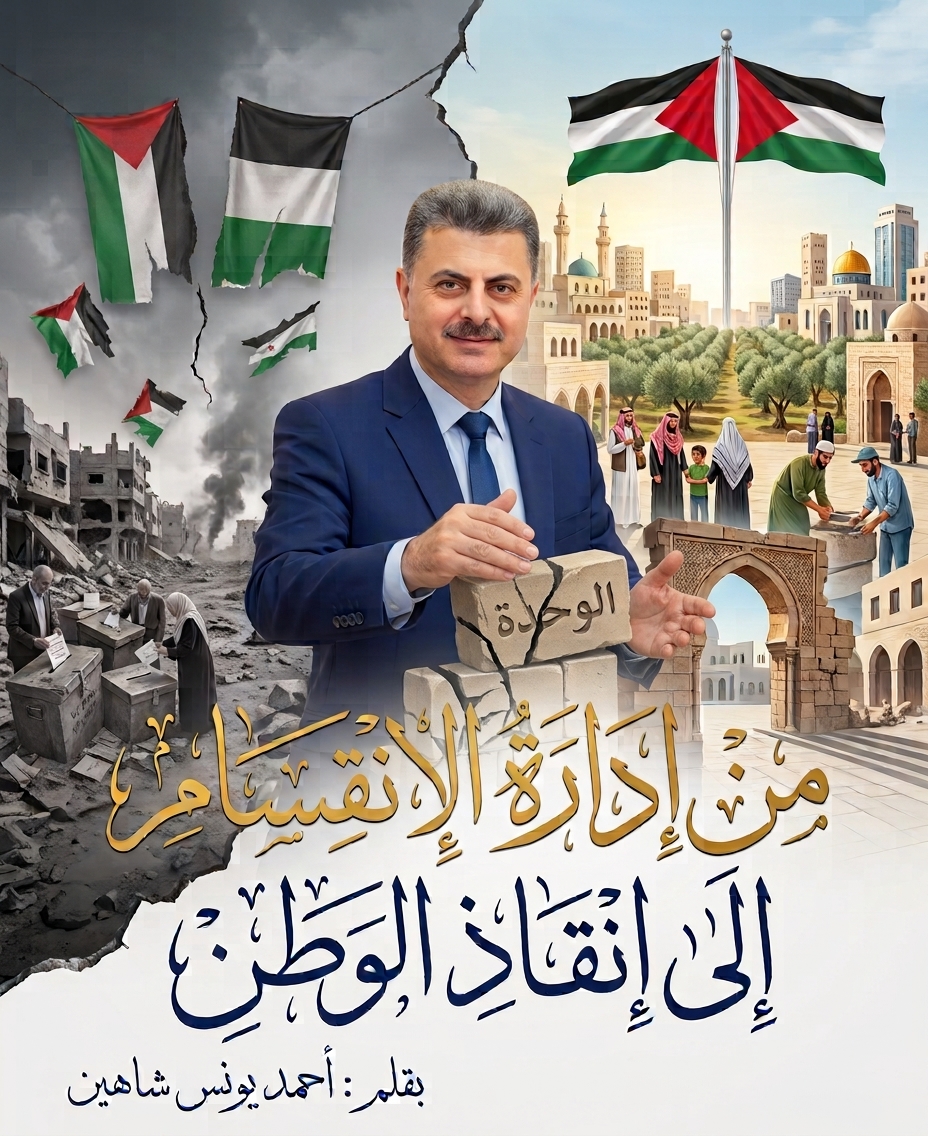
From Managing Division to Saving the Homeland
By: Ahmad Younis Shaheen Journalist For nearly two decades, the Palestinian political elite has fallen into the trap of what can be termed "engineering coexistence with division." The geographical and political rift between the West Bank and Gaza Strip has transformed from an emergency situation into a stable "current status," around which interests and influence have been built, and mechanisms have been established that made its continuation possible, albeit catastrophically. But this era has ended; the current events have placed everyone before a stark reality: managing division is no longer a viable option, and the only alternative today is to "save the homeland" through the gateways of stopping the genocide and moving towards the electoral entitlement. Throughout the past years, the prevailing approach has been to engage in factional dialogue rounds aimed, in reality, at improving the conditions of division rather than abolishing it. This palliative approach has been exploited by the occupation to isolate each Palestinian geography separately, until the most horrific genocide and comprehensive destruction witnessed by the Palestinian cause in modern times erupted. Now, in light of an ongoing existential war and clear plans for the displacement and political and administrative separation of Gaza from the West Bank, it has become evident that "managing division" was nothing but an organized waste of time and energies in favor of the Zionist project. The scale of sacrifices, the immense destruction, and attempts to impose "the day after" with an Israeli vision have made the transition from a mentality of "provocation" to a mentality of "salvation" a necessity marked by blood. This fateful transformation comes at a time when the Palestinian arena is approaching pivotal constitutional entitlements, highlighting the close link between ending the war and organizing the internal house. It is impossible to talk about conducting free and fair elections amidst the remains of victims and under the sound of bombardment and the siege of cities. Therefore, the mentality of salvation requires an immediate national agreement on a transitional phase led by a unified national consensus government, whose mission is limited to stopping the aggression, aiding the people, and beginning the reconstruction of what the war has destroyed in Gaza, alongside preparing the political, logistical, and security conditions for conducting elections simultaneously and comprehensively (in Gaza, the West Bank, and occupied Jerusalem). These elections should not deepen the division (as happened in 2006), but should be preceded by an agreement on a "code of honor" that ensures respect for the results and full political partnership regardless of the winner, so that the ballot box becomes a tool for rebuilding the political system rather than detonating it. The transition from management to salvation requires a radical shift in Palestinian political will and is based on two pillars: First: Politically investing sacrifices: The blood of martyrs and the growing international isolation of the occupation before international courts represent an unprecedented diplomatic leverage. However, this momentum will dissipate unless it is met with a unified Palestinian leadership under the umbrella of the Palestine Liberation Organization, presenting the world with a coherent political discourse that cuts off the pretext of "the absence of a partner." Second: Reciprocal concession of illusions: All factions must realize that any talk of "authority and influence" amidst the rubble and in the presence of tanks is an illusion. Saving the homeland means abandoning the mentality of exclusion or dominance and moving towards a genuine national partnership that protects the independent Palestinian decision. The truth that everyone must understand is that history does not forgive those standing in gray areas, and the Palestinian people, who have faced the fiercest wars with their chests and pains, can no longer bear more political maneuvering or rhetorical statements. The link between war and elections is a link between survival and legitimacy. Going to national dialogue today with a mentality of "salvation" means a brave consensus to stop the war, unify institutions, and pave the way for free elections that return the decision to the people. Either we agree to save what remains of the homeland, or we surrender to scenarios of liquidation and loss amidst the ashes of war.